CS 1 Publication (4)

Civil Society as the Possibility for Collective Freedom

This essay synthesises the evolving thinking of Conducive Space for Peace (CSP) on the linkages between civil society, peacebuilding, and the potential for global systems transformation. Informed by CSP’s RESPACE initiative, it draws on rich historical case studies, from the German workers’ movement and Black Reconstruction to anti-colonial liberation struggles and the rise of NGOs, to explore how ordinary people have self-organised to challenge domination and build alternative futures.

Dialogue Input Series (5)

World at Crossroads: From Scenarios to Action

The World at Crossroads Dialogue Input Series builds on the four RESPACE Scenarios that explore plausible futures for global collaboration for peace by 2035. The scenarios range from bleak to hopeful, offering a mirror to the present and inviting us to ask: How can today’s decisions shape tomorrow’s world? The Dialogue Inputs turn that mirror outward, addressing highly complex global, regional, and translocal developments occurring up to May 2025, through the lens of the RESPACE Scenarios. By doing so, they reveal how imagined futures are already unfolding and help us make sense of today’s rapidly evolving global landscape.

Untitled (1366 x 768 px) (7)

CHARTING TOMORROW Recommendations for a United Nations Embracing the Future

This briefing note is the CSP contribution to the ongoing process of review and reform of the UN peacebuilding architecture, inspired by the collective wisdom of the many actors with whom we have worked. It presents five actionable recommendations in the short to medium term and three perspectives for transformational changes needed to reimagine the UN for a new era. It is crafted with an acute awareness of the ambitious reform agenda set forth in the UN secretary-general’s New Agenda for Peace and the commitments made by UN member states in the Pact for the Future. They signal a renewed push to modernise multilateralism, strengthen global governance and ensure peacebuilding efforts are suitable for the complex world of today. The recommendations and perspectives in this Brief are intended to support the translation of the commitments into concrete, inclusive and meaningful changes that strengthen peacebuilding efforts worldwide.

Final Covers__Page_1

RESPACE Scenario Report

Explore the RESPACE scenarios! Click here to find four thought-provoking stories of what future global collaboration for sustainable peace could look like.

Graphic displaying a publication on a blue background.

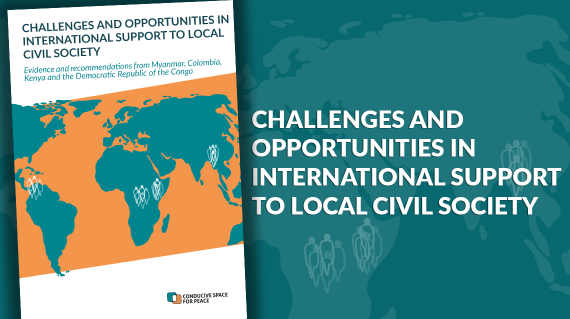
Challenges and Opportunities in International Support to Local Civil Society

Drawing upon the experiences and perspectives of primarily local civil society organisations, activists and their international counterparts, the report provides lessons and recommendations for supporting effective and sustainable peacebuilding and development. The report also contributes to ongoing discussions on localisation and decolonisation agendas, working to achieve a fairer distribution of power and advancing local leadership, thereby fostering more equitable partnerships and solidarity in international aid.
IP-Version-LinkedIn

Learning Note: Innovative Practices – Changing the International System to Better Enable Local Leadership

This learning note consolidates some of the innovative practices taking place within the aid system by different organisations and hopes to inspire all actors and institutions to learn from one another on concrete ways for changing the international system to better enable local leadership. In supporting systems change for local leadership, there is great potential in unlocking learning on practice innovations as one critical element in pursuing institutional and broader systems change, including structural and attitudinal change. In the coming months CSP will be hosting a series of events for deepening our shared learning and reflection on changing the international system for enabling local leadership and equitable partnerships.

Reflection-Note

Reflection Note: Systems Change is Driven by People

What is the role of individuals from where we stand to drive #systemschange for local leadership?

Check out the first of a series of reflection notes where we reflect on how people drive systems change for local leadership and equitable partnership in peacebuilding and development. We reflect on the important roles we all can play to unlock system change and specifically the role of those working ‘inside’ international organisations.

CPS_Chain-of-Influence_22_Facebook

Chain of Influence Framework for Systems Change – Shifting Power to Local Actors

Enhancing international support to local civil society organisations in conflict-affected contexts is increasingly recognised as critical to sustainable peacebuilding. Currently, too little peacebuilding and development funds reach local actors, and strengthening the quality of support can enable space for local leadership. The shorter-term, top-down, and externally driven engagements have not created the desired results for sustainable conflict prevention, peacebuilding, and development. Therefore, Conducive Space for Peace has since 2016 been developing thinking on and action for systems change to enable space for locally-led peacebuilding and development better.